Thanks to technological advancements and increasingly powerful and robust laser systems, these can now also be used for many applications in technically hostile environments (dirt, water, dust, heat, cold).
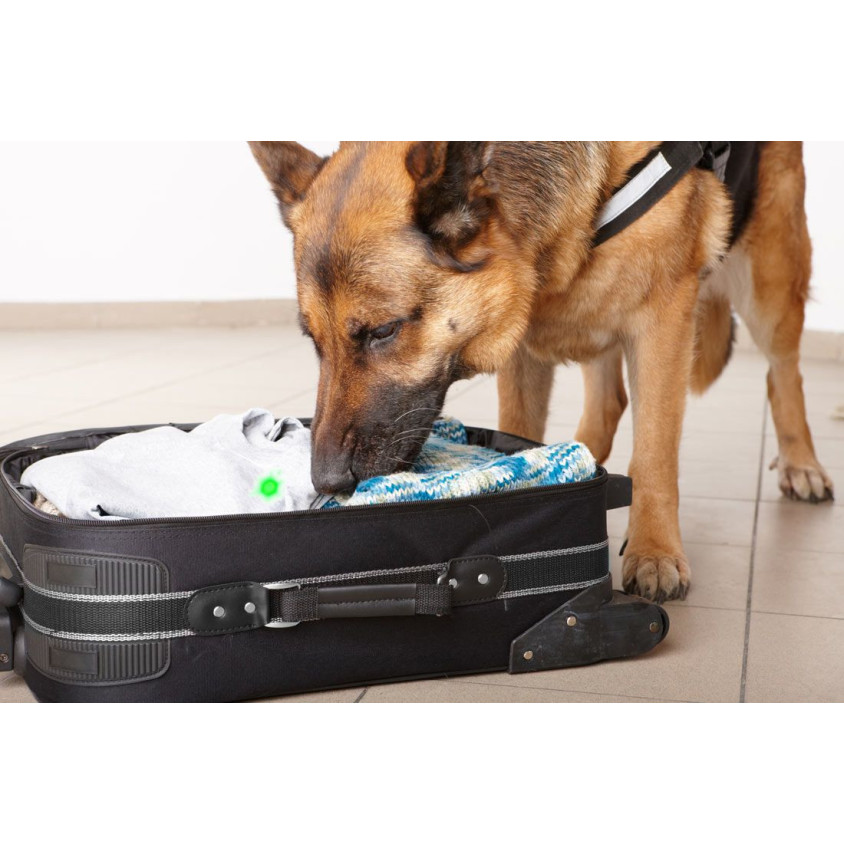
One of these application areas has recently been in training programs and for the training of detection, hunting, rescue, protection, and assistance dogs. The laser can be used to specifically mark objects and positions in the handler's field of vision. The laser provides the dog with a visual stimulus and can thus be guided precisely over long distances.
The advantage of working with lasers is that you are at a distance from the dog while it performs the actual task. This applies in particular if there is a risk to people, objects to be found (e.g., evidence), or if access to people is denied due to environmental conditions, for example, in the event of a disaster or the presence of obstacles. Depending on the laser's specification, nearby objects, as well as distant objects, can be visibly marked and thus become an instinctive target for the dog. Important aspects of dog training are the flexibility of the laser regarding different distances and targets, as well as eye safety for humans and animals, with consistently good visibility.
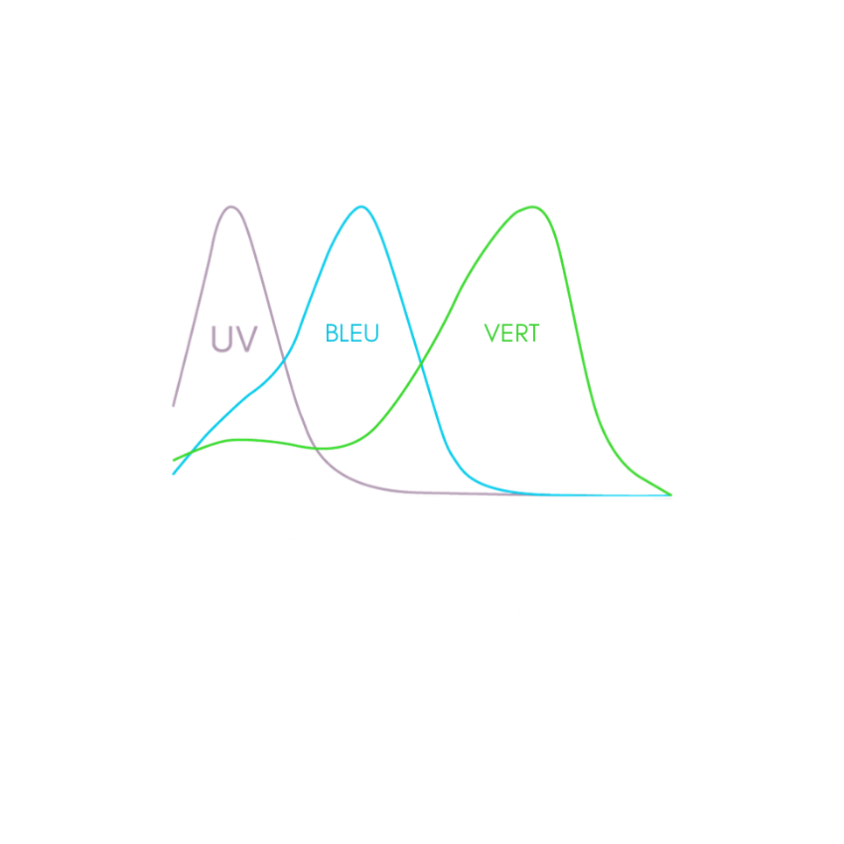
NOTES: Laser light must be visible to both humans and dogs. When determining the optimal wavelength, the anatomy and evolutionary development of the eye are of particular importance.
Most mammals are dichromats and have only 2 types of cones:
- SWS1 Cone: With sensitivity in the short-wavelength range of the spectrum, corresponding to the human blue cone.
- LWS Cone: Most sensitive to long-wavelength light.
The visual pigments of these two cone types are correspondingly designated as SWS1 (“short wavelength sensitive 1”) and LWS (“long wavelength sensitive”). During evolution, approximately 30 million years ago, the red cone emerged within the human species through a duplication and subsequent mutation of the gene responsible for the visual pigment of the lumbar column of the green cone in other mammals. The green cone exists, so to speak, twice in humans, whereby the sensitivity of the visual pigment of the lumbar column of one of these cones is shifted towards longer wavelengths (perceived as red by humans).
This results in up to ten times better visibility of the green wavelength spectrum in humans than red. The common interface when selecting an appropriate laser, so that both dogs and humans can recognize it well, is the wavelength range of approximately 500 to 600 nm. From a technical point of view, 520 nm diodes are ideal, as they are also more resistant to external influences than the 532 nm lasers used to date.
Once the dog has arrived at the marked position, it can perform a previously conditioned behavior. Working dogs are used by law enforcement, special forces, and commercial dog trainers worldwide to find substances and odors of all kinds. These include personal detection dogs, dogs used by police and military to find drugs, explosives, or evidence, wildlife detection dogs, and dogs used for hunting.
The use and training of these dogs and the associated autonomous search work detached from the handler require clear criteria for the respective task, as well as intensive training from the outset.
Areas of Application with the K9 LASER
Dog handling is currently mostly done using poor-quality lasers that are not approved and can be ordered cheaply online. With these lasers, the output power is generally well above the permitted limit values. Furthermore, the classification according to DIN EN 60825-1 usually does not correspond to the specified parameters, so there is considerable risk potential for the user's health. With law enforcement and commercial users, these lasers have long been under the supervision of laser safety officers due to their danger.
The durability and power consistency of these lasers fluctuate across different temperature ranges and make the use of the laser an incalculable danger to the eyes of humans and animals. Laser protection is often neglected by professional dog trainers and canine schools due to the danger of inconsistent light emanating from the laser.
The emitted light and haptics of these mass-produced lasers are therefore not suitable for use with dogs. For training with dogs, it is advisable to use a high-quality, precise, and safety-compliant laser. Performance and characteristics may be higher or lower, depending on the application, to account for distances and environmental conditions - as well as, if necessary, tactical conditions. In the best case, this can be done via various switchable modes and mechanical fuses to prevent accidental activation of high output.
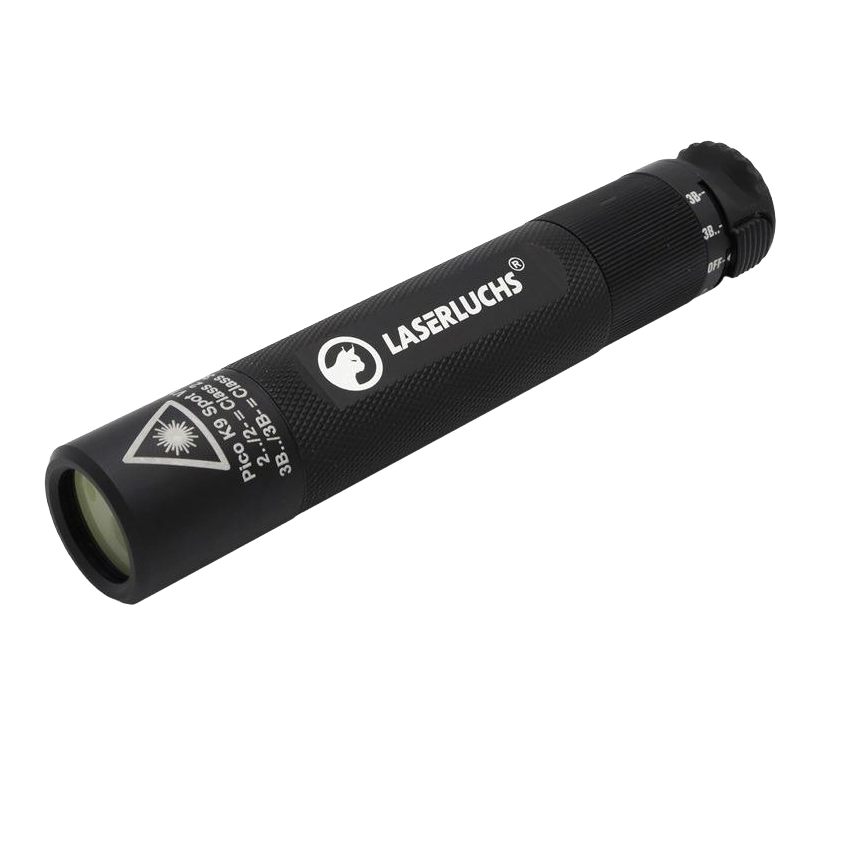
The K9 LASER fills this gap; it is a high-quality laser specifically designed for training programs and for the training of detection, hunting, rescue, protection, and assistance dogs.
During dog training, work is initially limited to short distances and darker lighting conditions, which should make it easier for the dog to visualize the light spot. A neutral training environment should make it easier for the dog to see a target in the laser spot without being distracted by the environment, always in combination with a valid reward as an instinctive goal.
Using a powerful laser not only harms the effect and enjoyment of work but also poses health risks to humans and animals during the training phase due to possible significant glare. For this reason, this laser can be used in a safe training mode with reduced power, allowing comfortable work with the dog.
A second mode has a flashing frequency of 8 Hz, which increases the visual stimulus as well as the perception of the laser spot in both humans and dogs. This takes advantage of the dog's better ability to detect movement. This increased visibility of light reflection is evident even on difficult terrain, such as undergrowth.
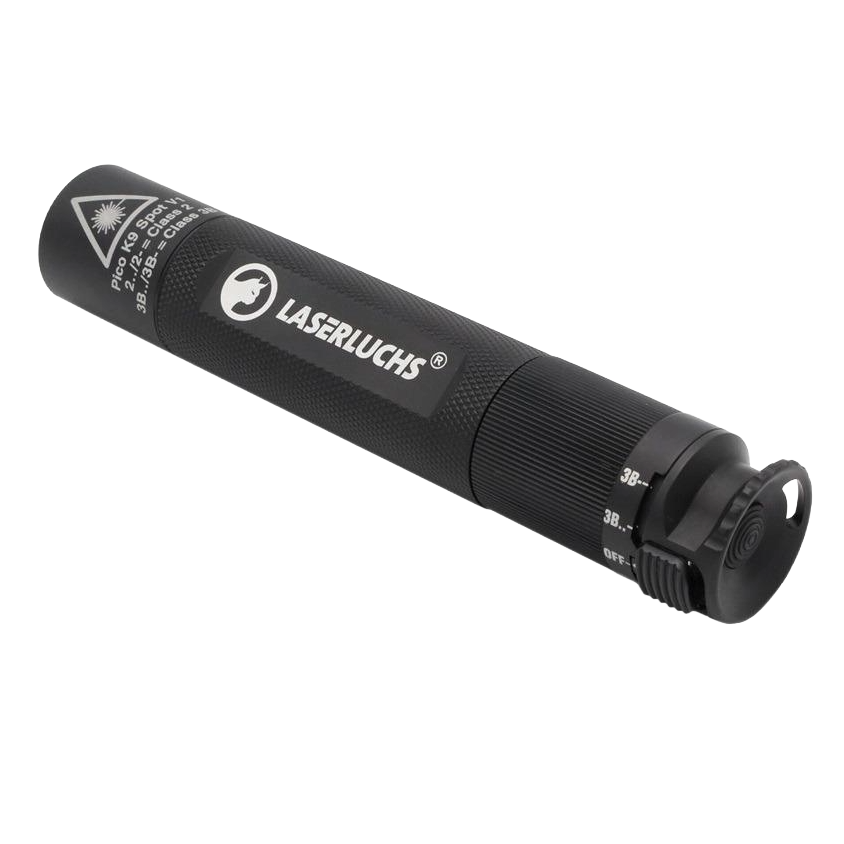
The laser's functionality is complemented by two other operating modes. For the laser's full light power, for example, for position displays over long distances in daylight or bright sunlight, the laser offers an "operational mode." This is secured by a special lock on the rotary switch, so that unintentional activation is prevented.
A variant with an 8 Hz flashing frequency has also been integrated for this mode to allow the laser to be adapted as flexibly as possible to the respective task and dominant environmental parameters.
The different operating modes are powered from a common source to reduce manufacturing effort. In addition, the K9 Laser has a robust black matte anodized housing, is waterproof, dustproof, and shockproof.
The desired mode is selected using a rotary switch, and the adjustment mode is activated using an additional button. The K9 Laser is also designed to be comfortably used with winter gloves or protective gloves.
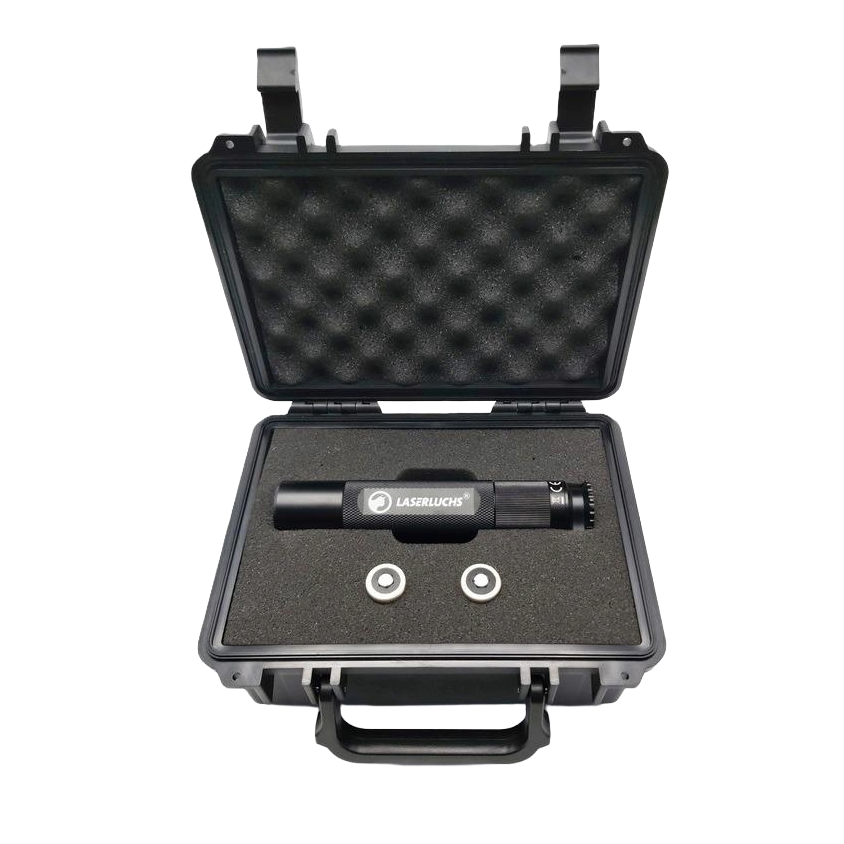
Further innovations such as holsters, foldable filters to reduce power, etc., enable the targeted use of a laser for remote dog guidance.
How are Dogs Trained with Laser Pointers?
Dogs respond well to remote work using lasers, which translates into well-structured training. The habit of working with the laser spot can vary from dog to dog. This requires good observation of the dog's reaction and good timing when delivering the reward.
At the beginning of training, it is recommended to combine stimuli known to the dog with the new visible laser spot at a shorter distance. To avoid eye damage, it is necessary to work with minimal light emission - for safety reasons for humans, and especially for the dog, as it is closer to the laser spot to accomplish the respective task and also because it could look directly into the beam. Possible reflections from certain surfaces also present a risk of glare due to scattered radiation. An intensification of this effect in darkness must also be taken into account, as human and animal pupils are wider and the risk of injury is greater.
Another method to draw the dog's attention to the laser light stimulus is to move the spot itself. This can be generated manually by moving the user's hand - or technically by a laser flashing function. It is advisable, depending on the objective of the remote work, to analyze beforehand the amount of stimulus the dog needs to achieve the specific goal. If, for example, the dog is supposed to grasp something at the marking point and retrieve it, this can be coupled with a reward that promotes training (toys, food).
The principle of conditioning is the combination of actions by forming sub-goals - starting with the desired behavior and then increasing the distance. All training variants can be easily integrated into a corresponding laser training design, always individually adapted to the respective dog and extended to the desired distance. Depending on the purpose, height, distance, or environmental conditions, the stimulus value and environmental conditions can be changed at will.
Tips for Training Dogs with Lasers
- Stimulus Analysis: Depending on the objective of remote work, analyze the amount of stimulus the dog needs to accomplish the task.
- Link to a Resource: Link the accomplishment of the task to a resource that promotes dedication (toys, food, etc.).
- Complex Tasks: When learning complex tasks, the link helps with the behavior that occurs once the laser spot is reached. This behavior is then the “reward.” After returning to the handler, the dog receives the “real” reward (food, treats).
- Start Training: Begin training the dog at short distances and in a darker environment so that the laser provides an easily visible contrast with the surroundings.
- Low-Stimulus Environment: Ensure the environment is low in stimulus, so the dog is not distracted by other sounds or light.
- Neutral Setup: Through a neutral setup, the dog should understand the meaning of the laser spot without any environmental distractions.
Technical Specifications
- Optimal Wavelength Range: Approximately 500 to 600 nm (for human and canine visibility).
- Ideal Diodes: 520 nm (more resistant than 532 nm lasers).
- Flashing Frequency: 8 Hz (for certain modes).
- Housing: Black matte anodized, robust, waterproof, dustproof, shockproof.
- Safety: Operational mode secured by a special lock on the rotary switch.
- Usage: Designed for comfortable use with winter gloves or protective gloves.
- Compliance: Designed to be a high-quality, precise, and safety-compliant laser (in contrast to poor-quality lasers not compliant with DIN EN 60825-1).